How plug-in solar works
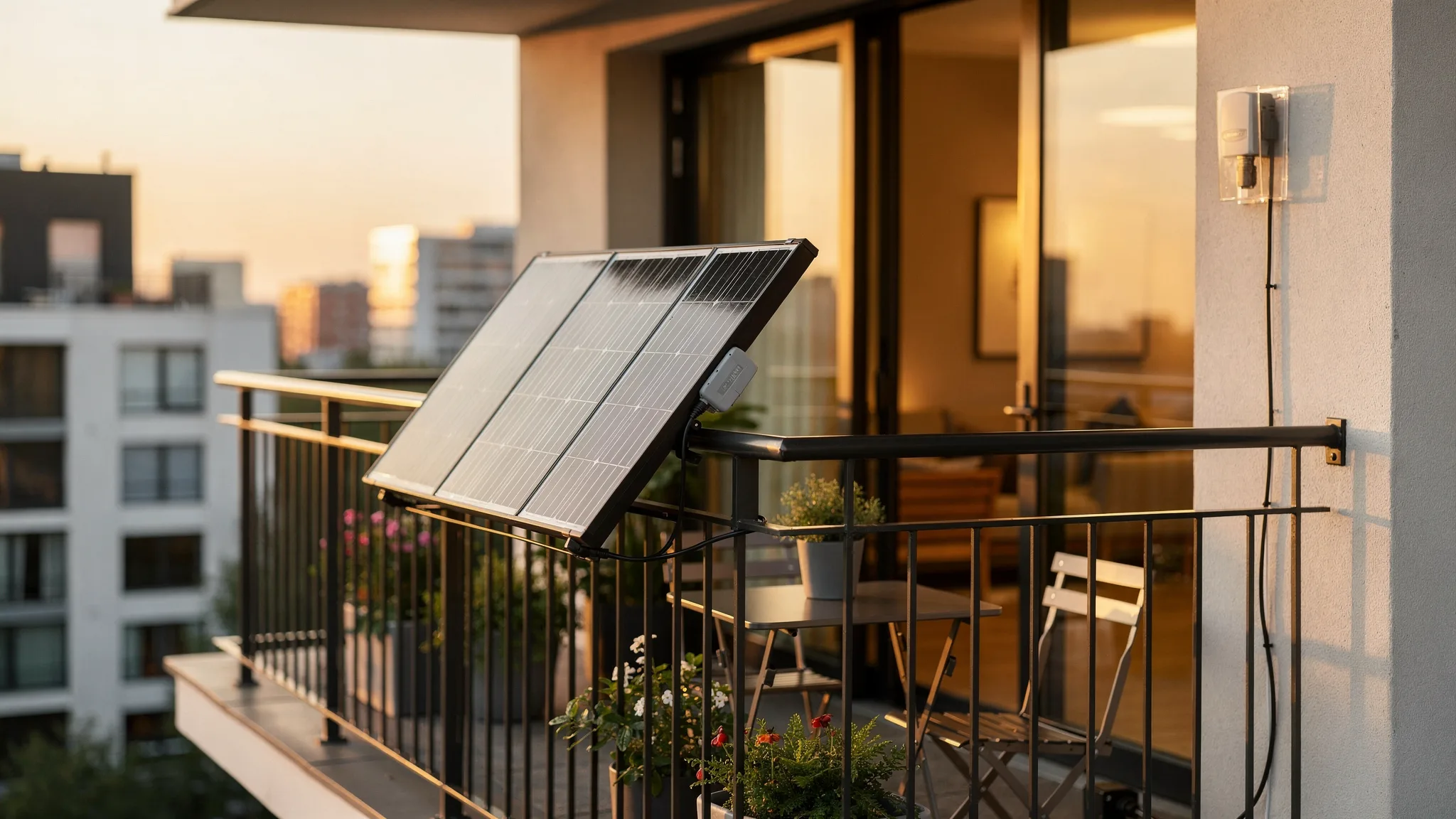
A plug-in kit is a small solar system that skips the installer. One or two panels feed a microinverter, which turns their DC power into household AC and pushes it into your wiring through an ordinary outlet.
Midday, home is busy
The panel's power takes the shortest path: straight to the fridge, router and TV. Your meter pulls less from the grid, and that's the saving.
- Panel
- 300 W
- Home using
- 420 W
- From grid
- 120 W
- To grid
- 0 W
Illustration with example numbers, not a measurement of any product.
The parts
- Panels. Usually one to four. Bright Saver's smallest kit is a single 180 W panel; US Solar Supplier's kit has two 405 W panels.
- Microinverter. The box that matters most for safety. It syncs with your grid power and must stop when the grid goes down.
- Cord and plug. Into a standard 120-volt outlet. Some kits use a proprietary connector on the inverter end.
- Optional battery or smart meter. Batteries store midday power; "zero-export" meters throttle the inverter so nothing flows past your meter.
Where the power goes
Electricity takes the nearest load. Power from the panel feeds whatever is running in your home first: the fridge, the router, the TV on standby. Your meter sees less demand, and your bill drops. If the panel makes more than the home uses at that moment, the extra flows out through the meter to the grid.
That last part is why the laws exist. Without one, a device that can push power onto the grid is treated like any rooftop system, which normally means an interconnection application and utility approval.
Why about 1,200 watts
Most state laws cap plug-in systems at 1,200 W, following Utah's 2025 law; Colorado allows 1,920 W. Stateline compared Utah's limit to the draw of a hair dryer. The cap keeps the current pushed back into a household circuit within what that circuit can carry alongside normal loads. The 391 W tier in Virginia, Maryland and Colorado goes further: below it, the system is exempt from listing rules that could require rewiring.
What it doesn't do
- It won't run your home in a blackout. A grid-tied inverter must shut off when the grid goes down. Only a battery system with its own outlets can supply power then.
- It won't earn you credit for exports in most states. Utah, Maine and Vermont exclude these devices from net metering.
- It won't cover a household's use. A 400 W kit makes a fraction of what a typical rooftop array does.
Next: is it safe? or is it legal where you live?